01 02 03 Miss Smartie's Sewing 04 05 15 16 17 18 19 20 21 24 21 24 21 24 25 26 27 28 29

Miss Smartie's Sewing

30 31 32 36 32 36 32 36 37 38 body { background:#aba; margin:0; padding:20px 10px; text-align:center; font:x-small/1.5em "Trebuchet MS",Verdana,Arial,Sans-serif; color:#333; font-size/* */:/**/small; font-size: /**/small; } /* Page Structure ----------------------------------------------- */ /* The images which help create rounded corners depend on the following widths and measurements. If you want to change these measurements, the images will also need to change. */ @media all { #content { width:740px; margin:0 auto; text-align:left; } #main { width:485px; float:left; background:#fff url("https://resources.blogblog.com/blogblog/data/rounders/corners_main_bot.gif") no-repeat left bottom; margin:15px 0 0; padding:0 0 10px; color:#000; font-size:97%; line-height:1.5em; } #main2 { float:left; width:100%; background:url("https://resources.blogblog.com/blogblog/data/rounders/corners_main_top.gif") no-repeat left top; padding:10px 0 0; } #main3 { background:url("https://resources.blogblog.com/blogblog/data/rounders/rails_main.gif") repeat-y; padding:0; } #sidebar { width:240px; float:right; margin:15px 0 0; font-size:97%; line-height:1.5em; } } @media handheld { #content { width:90%; } #main { width:100%; float:none; background:#fff; } #main2 { float:none; background:none; } #main3 { background:none; padding:0; } #sidebar { width:100%; float:none; } } /* Links ----------------------------------------------- */ a:link { color:#258; } a:visited { color:#666; } a:hover { color:#c63; } a img { border-width:0; } /* Blog Header ----------------------------------------------- */ @media all { #header { background:#456 url("https://resources.blogblog.com/blogblog/data/rounders/corners_cap_top.gif") no-repeat left top; margin:0 0 0; padding:8px 0 0; color:#fff; } #header div { background:url("https://resources.blogblog.com/blogblog/data/rounders/corners_cap_bot.gif") no-repeat left bottom; padding:0 15px 8px; } } @media handheld { #header { background:#456; } #header div { background:none; } } #blog-title { margin:0; padding:10px 30px 5px; font-size:200%; line-height:1.2em; } #blog-title a { text-decoration:none; color:#fff; } #description { margin:0; padding:5px 30px 10px; font-size:94%; line-height:1.5em; } /* Posts ----------------------------------------------- */ .date-header { margin:0 28px 0 43px; font-size:85%; line-height:2em; text-transform:uppercase; letter-spacing:.2em; color:#357; } .post { margin:.3em 0 25px; padding:0 13px; border:1px dotted #bbb; border-width:1px 0; } .post-title { margin:0; font-size:135%; line-height:1.5em; background:url("https://resources.blogblog.com/blogblog/data/rounders/icon_arrow.gif") no-repeat 10px .5em; display:block; border:1px dotted #bbb; border-width:0 1px 1px; padding:2px 14px 2px 29px; color:#333; } a.title-link, .post-title strong { text-decoration:none; display:block; } a.title-link:hover { background-color:#ded; color:#000; } .post-body { border:1px dotted #bbb; border-width:0 1px 1px; border-bottom-color:#fff; padding:10px 14px 1px 29px; } html>body .post-body { border-bottom-width:0; } .post p { margin:0 0 .75em; } p.post-footer { background:#ded; margin:0; padding:2px 14px 2px 29px; border:1px dotted #bbb; border-width:1px; border-bottom:1px solid #eee; font-size:100%; line-height:1.5em; color:#666; text-align:right; } html>body p.post-footer { border-bottom-color:transparent; } p.post-footer em { display:block; float:left; text-align:left; font-style:normal; } a.comment-link { /* IE5.0/Win doesn't apply padding to inline elements, so we hide these two declarations from it */ background/* */:/**/url("https://resources.blogblog.com/blogblog/data/rounders/icon_comment.gif") no-repeat 0 45%; padding-left:14px; } html>body a.comment-link { /* Respecified, for IE5/Mac's benefit */ background:url("https://resources.blogblog.com/blogblog/data/rounders/icon_comment.gif") no-repeat 0 45%; padding-left:14px; } .post img { margin:0 0 5px 0; padding:4px; border:1px solid #ccc; } blockquote { margin:.75em 0; border:1px dotted #ccc; border-width:1px 0; padding:5px 15px; color:#666; } .post blockquote p { margin:.5em 0; } /* Comments ----------------------------------------------- */ #comments { margin:-25px 13px 0; border:1px dotted #ccc; border-width:0 1px 1px; padding:20px 0 15px 0; } #comments h4 { margin:0 0 10px; padding:0 14px 2px 29px; border-bottom:1px dotted #ccc; font-size:120%; line-height:1.4em; color:#333; } #comments-block { margin:0 15px 0 9px; } .comment-data { background:url("https://resources.blogblog.com/blogblog/data/rounders/icon_comment.gif") no-repeat 2px .3em; margin:.5em 0; padding:0 0 0 20px; color:#666; } .comment-poster { font-weight:bold; } .comment-body { margin:0 0 1.25em; padding:0 0 0 20px; } .comment-body p { margin:0 0 .5em; } .comment-timestamp { margin:0 0 .5em; padding:0 0 .75em 20px; color:#666; } .comment-timestamp a:link { color:#666; } .deleted-comment { font-style:italic; color:gray; } .paging-control-container { float: right; margin: 0px 6px 0px 0px; font-size: 80%; } .unneeded-paging-control { visibility: hidden; } /* Profile ----------------------------------------------- */ @media all { #profile-container { background:#cdc url("https://resources.blogblog.com/blogblog/data/rounders/corners_prof_bot.gif") no-repeat left bottom; margin:0 0 15px; padding:0 0 10px; color:#345; } #profile-container h2 { background:url("https://resources.blogblog.com/blogblog/data/rounders/corners_prof_top.gif") no-repeat left top; padding:10px 15px .2em; margin:0; border-width:0; font-size:115%; line-height:1.5em; color:#234; } } @media handheld { #profile-container { background:#cdc; } #profile-container h2 { background:none; } } .profile-datablock { margin:0 15px .5em; border-top:1px dotted #aba; padding-top:8px; } .profile-img {display:inline;} .profile-img img { float:left; margin:0 10px 5px 0; border:4px solid #fff; } .profile-data strong { display:block; } #profile-container p { margin:0 15px .5em; } #profile-container .profile-textblock { clear:left; } #profile-container a { color:#258; } .profile-link a { background:url("https://resources.blogblog.com/blogblog/data/rounders/icon_profile.gif") no-repeat 0 .1em; padding-left:15px; font-weight:bold; } ul.profile-datablock { list-style-type:none; } /* Sidebar Boxes ----------------------------------------------- */ @media all { .box { background:#fff url("https://resources.blogblog.com/blogblog/data/rounders/corners_side_top.gif") no-repeat left top; margin:0 0 15px; padding:10px 0 0; color:#666; } .box2 { background:url("https://resources.blogblog.com/blogblog/data/rounders/corners_side_bot.gif") no-repeat left bottom; padding:0 13px 8px; } } @media handheld { .box { background:#fff; } .box2 { background:none; } } .sidebar-title { margin:0; padding:0 0 .2em; border-bottom:1px dotted #9b9; font-size:115%; line-height:1.5em; color:#333; } .box ul { margin:.5em 0 1.25em; padding:0 0px; list-style:none; } .box ul li { background:url("https://resources.blogblog.com/blogblog/data/rounders/icon_arrow_sm.gif") no-repeat 2px .25em; margin:0; padding:0 0 3px 16px; margin-bottom:3px; border-bottom:1px dotted #eee; line-height:1.4em; } .box p { margin:0 0 .6em; } /* Footer ----------------------------------------------- */ #footer { clear:both; margin:0; padding:15px 0 0; } @media all { #footer div { background:#456 url("https://resources.blogblog.com/blogblog/data/rounders/corners_cap_top.gif") no-repeat left top; padding:8px 0 0; color:#fff; } #footer div div { background:url("https://resources.blogblog.com/blogblog/data/rounders/corners_cap_bot.gif") no-repeat left bottom; padding:0 15px 8px; } } @media handheld { #footer div { background:#456; } #footer div div { background:none; } } #footer hr {display:none;} #footer p {margin:0;} #footer a {color:#fff;} /* Feeds ----------------------------------------------- */ #blogfeeds { } #postfeeds { padding:0 15px 0; }

Sunday, 11 January 2015

The Secretary Blouse

Hi there, I've made myself useful over the last few months and taught myself how to draw patterns digitally. I wanted To make some patterns that would fit Both Me and a friend so I've had to tackle grading as well. Since I fell in love with american sewing patterns, love at first use you could say, I also had to incorporate seam allowances, notches and other symbols. This was harder than I thought it would be. There were a lot of failed attempts but every time I messed up I learnt something new so I got up and went on tinkering with CAD-programs and looking for a way to make these patterns printable.

At last I think I have succeeded. A digital pattern of my own design print and share ready. I'll give a review of the Style on this page and you'll find additional pages with the pattern itself, instructions on the measurements system and on how to put everything together in the end. I've made this style for myself as a test piece (and yes discovering a couple of flaws that I had overlooked) and I'll use this for a step by step construction guide of the pattern. A small disclaimer: I'm no professional pattern designer so some notches and symbols might be of by a couple of mm. While constructing most pieces went together fine however. I'd suggest walking the pattern in your size as a precaution to make sure everything is perfect in one go. If you find any mistakes I'd be happy to correct them for later users. In the meantime, have fun sewing!

Measurement and pattern
Construction part 1
Construction part 2
Pattern adjustment tutorial

Inspiration

inspiration dress by pin-up couture
I've been in love with the retro jet modern designs of pin-up/rockabilly clothing for a while now. I love how they combine a very feminine look with a modern twist. I also like to look good but be comfortable in my clothes. That's when the idea of a stretch shirt first started appealing to me. The look that started it all for this pattern was the secretary dress by Pin Up Couture. I've posted a picture above. It prompted me to attempt my first high waisted skirts and I kept dreaming of a blouse that would look equally stunning. I soon realised I hadn't found this design in any shop yet and I started to wonder on how I could possibly recreate this look myself. I didn't go for an exact copy of the dress but I wanted to copy the look of the collar and cuffs.

Design specifics

design sketch of the blouse
This blouse is very fitted and features a large plunging neckline in a classic collar style. I myself like fitted blouses and I wanted something special but comfortable. That's why I chose stretchy fabric.I really liked the way the collar and cuffs stand out in the inspiration piece. I decided To Go with princess seams in the front and the back to give the garment it's shape. I love how these seams accentuate the female form.  I wanted to hide the necessary crossing of the center pieces in the front seam to give everything a more finished look. This also ensures that the garment is still modest enough.  I wanted the collar to look like a kind of halter and achieved this by making the neckline pretty  narrow in the back. This accounts for the very broad shoulderseams. I think these fit the look.
The whole thing is finished with a front and back facing, the front facing is also an armhole facing, this makes sure that the collar stays where it should be. It also allowed me to use the facing as a modesty measure to make see through fabricks opaque.

finished garment front
back

As I mentioned this design has been made with stretch fabrics in mind. Do not attempt do do otherwise unless you want to change the fabric. I learnt the hard way seeing that my fabric, although a stretch fabric wouldn't stretch far enough to take the garment on and of comfortably. It looks good though and feels OK while wearing it, so I just added a zipper in the side seam. To make sure the fabric for this Blouse is stretchy enough ten cm of folded fabric should be able to stretch to 14 cm.

Process


For those who are interested I'll give a quick overview of the process I went through making this pattern. I started out by pinning the design lines that I wanted to achieve on a mannequin with woollen threads as you can see above. When I was happy with the overall result I pined some fabric paper on my mannequin and traced the lines I wanted. I achieved a first 2D pattern that way. Next I cleaned up the design lines while adding the necessary design ease. I then averaged (essentially I made sure seams that had to go together in the end matched up while flat) the design to make sure the seams would fit more nicely while sewing everything up and the result would look cleaner.
I then went into CAD and drew the pattern digitally. Since I don't have any real means of digitising I had to use good old geometry to transfer the design. I then began by adding notches, and placement marks walking and checking these again digitally. The next step was adding grading, and transferring the pattern to something printable. I've used illustrator for this purpose (since I don't own any programs that would allow me to print on an ordinary printer) and it works pretty well. The only downside is that the pattern sizes lose their formatting and some of the pattern lines and especially notches get distorted. This adds a lot of work, formatting the sizing, adding markings by hand witch then have to be walked and checked by hand again and sometimes redrawing parts of the pattern (especially the armholes and the front facing). I sincerely hope that the pattern turned out ok. I've already made up my base size (the one that fit's the mannequin) and that went pretty well. I'm going to make up a bigger size for a friend to test the grading. So far everything looks good though.

I'll finish with some extra pictures of the garment:


Labels: , , , ,

Tuesday, 1 April 2014

the Joan dress fitting and sewing

I wrote this post wile putting together the muslins for the Joan dress I made. This was partly to have a guide for myself when I had to put the real dress together later on and just to completely share the process with you.

I made two muslins and the real dress. I adjusted the pattern that much during that first stage that I felt it necessary to make a whole new one. I should have put more time in adjusting the sleeves because they do not look right at the moment. Luckily my arms are still usable.

Cutting out the fabric

I found cutting out the pattern pieces so they would all be right side up in the finished product one of the most challenging problems in pattern drafting. Since this dress is Asymmetrical getting that right was essential. I do not have any tips that are foolproof but I try to put the direction to cut the patter pieces in on the pattern itself. I didn't count on changing the direction of how the fabric. Is laying however. So I should add witch side of the pattern should be cut with witch side of the fabric up next time.

these are the pattern pieces:

back bodice on the fold
back skirt on the fold
front skirt on the fold (accidentally but I thought the excess worked well as a facing.)
yoke on the fold
left half of the front skirt.
waistband twice
left bodice front
right bodice front
collar and facing for front

I added the required seam allowances (4 cm for the hem at the bottom, 1.5 cm everywhere else except the edges of the facing) if you haven't done so in your final pattern. If you are only making a muslin I recommend to leave the pattern pieces without seam allowance or mark it of very clearly. Seam allowance can get in the way while cutting and slashing the pieces to adjust them and makes it more difficult to make changes while fitting the muslin in my opinion.

Sewing

I'll start with sewing all of the darts and pleats. I'm trying to finish the pattern pieces separately (front, back, skirt, bodice, waistband) and then add them together at the end.

1. Sew the darts in the back bodice and the front bodice. Nothing special here.
2. Sew the pleats in the skirt parts.
      Had my doubts about the fact that I designed the front pleats to be sewed down. I liked my back  pleats however so I kept the front design as well. Make sure to iron the pleats to the sides on both pattern pieces.
3. Sew the yoke to the back and front bodice parts. Try this on. check the placement of the horizontal seams. Make sure the seam line is continuous. That means that the edge should not be jaggedly jumping around.
4. Sew the front facing and collar to the bodice. Make sure to cut and pin your facing part the right way! I messed up the first time. You want a mirror part of your bodice, so if the rectangle of your bodice faces right, face the rectangle of the facing left while cutting.  There is a part where you have to snip the collar to be able to sew it properly. This is the left top if te rectangle. Make sure to pin and check the placement of the pins. Sew the edges of the collar back together. Just put seam on seam. I used bias binding to make a clean finish here in my final dress. Iron in the collar pleats. Use steam.
5. Sew the facing to the left bodice piece making sure the pinned fit is right first. sew the facing in two places at the end of the fabric and in the crease of the fabric. But make sure that you keep the loose flap effect. Do not sew to close to the seam. Depending on where the flap goes it will try to fold back on itself. Try to secure this with hand stitching while fitting. Sew up on the inside up until the part where the fabric should fold over.
6. sew the side seams, leaving room for the zipper in the left seam.
7. Sew the front skirt pieces together. leaving a split in the front. Check how much these pieces should overlap depending on the bodice. the flap must seam continuous. Sew along the top of this pattern piece to ensure that the pleat stays right. Iron the pleat in. I might also try some interfacing to get the required stiffness.
8. sew the side seams leaving room for the zipper in the left.
9. connect bodice and skirt with the waistband.
10. Set in the sleeves.

the second muslin
for the second muslin I redrew All pattern pieces so that the seam allowance is included. this makes the cutting and constructing a lot easier. If you do this make sure that the seams align and not just the seam allowances. There is a difference sometimes and it might make you put the notches wrong or put the whole thing together badly.

I was able to sew this in approximatelyone day. Constructionwent pretty smoothly. I did make some mistakes in the real dress because of deadline stress. I used French seams as much as possible and bias binding where it was not. For the hem I used a blind hem.

 I'm happy I took the trouble of testing this dress for a second time but should have tweaked the sleeves more. I feel however confident that I will be able to fix this.

Labels: , , , , , ,

Sunday, 9 March 2014

The basic dress sloper: drafting tutorial

Now for the drafting of our sloper. If you are reading this you should have gathered the materials listed in the previous post and have an accurate set of your body measurements.

The paper: 

set out with a piece of pattern paper measuring half of your bust measurement + 15 cm wide and the length of your body -50 cm.

Adjusting measurements for ease:

Something crucial in making garments is ease. This will allow you to actually move in the clothing you design. There is a minimum wearing ease that is 6 cm in the bust area, 2 cm in the waist and 4 in the hips. Some sources will list other measurements, but these values work for me. I like to keep my wearing ease as small as possible and let the design ease take care of itself in the design process. Mark the extra values on your list of measurements and make the calculation. You will need to use these measurements multiple times and it's easy to forget to add the extra cm at one point. This will ruin your garment for you. That's why it's important to have the new measurement clearly on your list of measurements while working. (This will also save you the headache of having to start a garment over when you forget your wearing ease)

Half and quarter measurements

Since This is a pattern that's meant to go on the fold of the fabric it only pictures half of your body. That's logical since your body would normally be symmetrical and this saves us a lot of pattern paper and it makes drafting and cutting the pattern a lot easier. Because of this we will be using a lot of half and quarter measurements. Do not freak out, the garment will end up with the right measurements! We quarter measurements since half of our drawing will be half of the front body and the other half will be half of our back. (Made more sense in my head) You will see what I'm getting at here wile we are drafting...

The basic layout

Draw a line parallel with the bottom of your paper. This will be your knee line. I like to make a real dress sloper out of these patterns because I tend to make mostly dresses. You could do a shorter version ending at the hips. Drafting the whole thing enables me to mark some standard lengths for my skirts, which saves me a lot of time while drafting, since I tend to want to measure how log I want something to be, then start trying to measure myself, ending up with a measurement that's completely wrong, realising this, just guessing what length I will need, reasoning that I can always cut of the excess fabric and measuring some extra, and then waste fabric or end up with a super fat hem for being lazy and not cutting the excess off.


Ok, sorry for drifting off topic, next you draw to lines perpendicular to this first line and logically parallel to the side edges of the paper. Do this approximately five centimetres from the edge of the paper. The black line in the picture should measure half of your hip measurement + 5 cm. These two lines will be the centre back and centre front of your block. Mark these if you feel like doing so. I like to add the cut this pattern on fold symbol with the arrows on these lines.

Next measure your waist to hip length on both sides of the pattern. Connect these points by squaring of of the sides or with a long ruler. By measuring both sides you ensure that the line you draw is straight and parallel to the knee line. (This is important for a good fit and an accurate pattern). The line you just drew is your waistline. (indicated in orange above) I like to mark that in a subtle way, just to make things easier for yourself. You can also inscribe your waist measurement and the amount of ease you used here.


You can already see we are going along a perpendicular to the sides parallel with the knees and waist theme here. Its just easy to add these construction lines all in one go. Measure the waist to hip measurement down from the waistline on both sides. Connect these points or square of from this point. This is the hip line.

Next we are going to construct the bust line. This is in fact the line where our armholes will begin and lies above the real bust line. To do this, measure the height of the arm and subtract 2 cm from that measurement. These two centimetres are necessary to be able to move your arms in your pattern. Square this line off like you did with the previous measurements.

The side seams


We can now start constructing the side seams. Since our body will always be bigger at the front than at the back at bust level (yes even if you have small breasts) we have to do something to take that difference into account. By making the front bodice bigger than the back bodice we actually move the side seams back and into place. The amount of difference between front and back bodice differs for different breast sizes, as a rule you should add 1.25 cm for every cup size you have. So an  A would add 1.25 cm, a B would add 2.5 cm, a C would add 3.75 cm,...
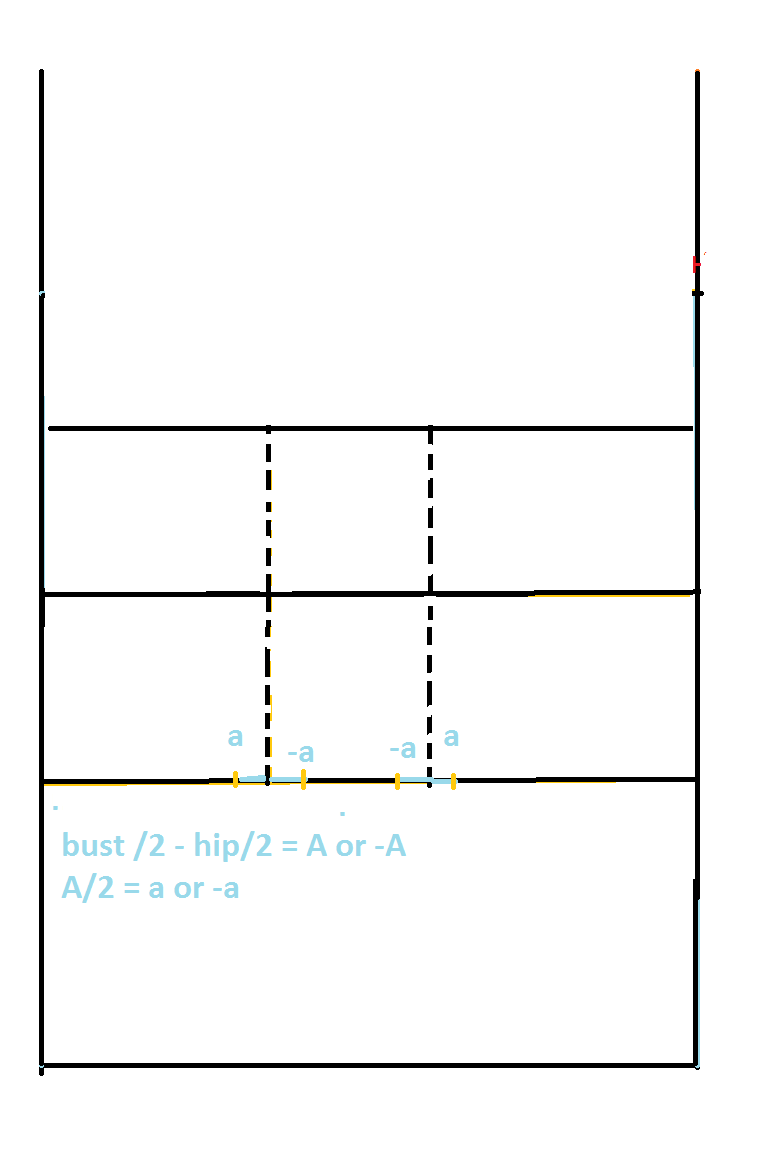
To construct these lines measure one fourth of the bust circumference minus the difference for your cup size from the centre back line and mark that point. Square off or measure the same distance on the waist and hip line and connect the points. Since these are construction lines, you can leave them as dotted lines or draw them in pencil.  Measure one fourth of the bust circumference plus the amount required for your cup size for the front bodice from the centre front seam. Mark that point and square off as before.

We are off course no rectangles (or at least we hope we are not). In the next step we will take the form of our hips into account. Some women's bust is larger than their hips, for others it's the other way around. To figure out what applies to you, you can just see which of your body measurements is bigger. That doesn't take into account how much bigger though. That is why we will subtract half of our hip measurement from half of our bust measurement. That way we know exactly how much difference we have to take into account. If the result you get is negative, your hips are larger than your bust (you can double check if you like), you will have to add half of the result to the dotted line you drew earlier. (Adding needs to be done away from your centre front and back line so right of the left dotted line and left of the right dotted line (-a in the picture). If your bust is bigger than your hips you will have a positive result. measure half of that result off of the dotted lines (a in the picture).

Measuring up


Measure the back length on the left side starting from your waist. This determines where your shoulder and neck seams will go. Square off with a temporary line. Next measure the over bust length to determine where your shoulder should go at the front. Square off with a temporary line.


Waist not


You might have noticed that the potato sac we've currently drawn is far to big in the waist. This is of course remedied by waist darts and adjusting the side seams. To determine where the waist darts should measure half of the bust separation from the centre front. Square off with a temporary line. Use the same measurement at the back, but this time subtract an additional 0.5 cm. Square off as seen on the picture.

To calculate how much excess fabric we have to remove subtract half the waist measurement from half of the bust measurement. As we have four places to remove this excess fabric .... the resulting measurement by four. Since it will give a nicer finish to take more fabric away at the side seams than in the darts add 0.5 cm to the amount you will measure at the side seams and subtract 0.5 from the amount you will take away at the darts. You can now mark the orange points in the picture. Make sure to measure half of the dart width to the left and half of the dart width to the right of the dotted line. (as more or less seen in the picture)


Some last points to mark. Our bottom is bigger at the back than the front. That's why we will let the dart end somewhere above our hip measurement. This allows for some extra room. The amount used here is usually 2.5 cm. This is however arbitrary and can be changed to your liking. The same goes for your breast measurement. Remember how we said in the beginning that our bust line was actually our armhole line? You will have to determine the placement of your real bust point. Do this by measuring your bust point to waist measurement up from the waist over the dotted line. Mark that point as Bust point. (This is a handy reference point in later pattern adjustments. 

In the next step simply connect all points as seen in the picture on the right.


Because our hips are curved in real life, we're going to curve them too. measure eight cm down along the side seams from the waist. Measure out 1 cm parallel to the waist (perpendicular to the dotted line you drew in). Connect these three points with a French curve. 

Draw a straight line down from the hip to make the side seam of the skirt.


Shoulder and neck seams


Measure 6 cm from the centre back along the line you drew earlier, this is a fixed measurement for the neck. mark this point. Measure another 9 cm to the right and 3 cm down. Mark this point as well. Do the same for the front bodice. The only difference is that the fixed measurement there is 6.5 cm.
Now you can draw the shoulders. Connect the two points you made earlier with a straight line, exactly the length of the shoulder measurement. Add 1 cm to the line in the back bodice. These are temporary lines  and will have to be adjusted later on.


Next we will determine the neck depth. at the back this is another arbitrary measurement, usually 1 cm. In front use the neck depth measurement you took. Connect all lines with a French curve. 

Armholes and shoulder darts


Measure the line resulting between the neckline and bust line. Divide by two, but mark the point 1 cm below half of the line. Measure and mark half of the cross back width. Connect the three points with a French curve.


Now for the other arm. This will be a bit trickier. Divide the line between bust and neckline by three. Measure one third down from the neckline and draw a temporary line perpendicular to the centre front. 

We have to decide where to put our front shoulder dart next. Take half of the bust separation plus 3 cm. Put the zero for your ruler on the centre front seam and slide up, perpendicular to the centre front. When the measurement you took crosses the shoulder line (as seen in the picture) stop and mark this point.


Connect this point to the bust line at the dart you drew earlier. Next measure the dart width along the shoulder line you drew at fist. The dart width is a fixed measurement and depends on your bust size. Someone with a bust size larger than 80 cm and smaller than 90 cm would have to measure 6.5 cm. Someone with a bust size between 90 and 100 would have a dart width of 7,5 cm, for busts over 100 the bust width would be 9.5, for busts of 110cm the width would be 12 and for bust sizes starting from 125cm the bust width will be 15cm. Connect this point to the bust line as well.
T
The next point is the trickiest part of the whole process. You will have to close the dart to get the pattern just right. If you have sewn before this will likely be no real challenge. Fold the right dart line in such a way that it lies directly on top of the left dart line. This becomes considerably easier if you let the majority of the patter hang from a table. Position the dart point (bust point) on the corner of the table and let all of the lines under the bust line hang over the side. When you have folded the pattern successfully (and checked that the sides of the dart do line up correctly) take a ruler and extend the two lines (shoulder and chest line) as shown on the picture. It's not necessary to measure correctly at this point, but you eliminate an extra step by doing so. Check that the shoulder seam is exactly as long as the shoulder measurement. Check that the chest line (between shoulder and bust) is exactly as long as half of the chest measurement.

Put the pattern paper back in place and unfold the dart. You should now have a dart and a pattern piece that is slightly slanted (more or less as shown above). You can double check the measurement for the shoulder and chest by measuring the part right of the dart (the one you constructed first) and adding that to the part you have constructed after that. Connect the three points you have now constructed with a French curve.


It's time for the last construction: the back shoulder dart. Remember how we added one extra cm? We will have to take that away to make the shoulders match op correctly. Why bother doing this? Ever noticed that your shoulders aren't really flat either? They are curves too, and they need the dart to ensure the proper round shape of the arm. Constructing it is easy. First you'll have to extend the dotted line you made before (the one for the back dart) once you have done so, measure 9 cm down from the shoulder along this line. Mark this point. Next measure 0.5 cm left and right of the point where the dotted line crosses the shoulder line. Mark these as well. connect both to the point you marked first. Notice how the dart is asymmetrical? We will have to fix this or our patter wont line up. Measure the length of the left dart leg. (the longest one) make sure the shorter one has the same length (measure and add the necessary line) mark that point. connect this last point to the shoulder tip you created earlier (end of the shoulder on the right).

Congratulations! You have successfully drafted a pattern block! It should look somewhat like this! (Note that I didn't use any real measurements wile making this diagram in paint, and that all sets of measurements differ somewhat so your pattern will look somewhat different, and that is of course the point of a good fit...) You can add some height measurements for skirt lengths if you like (as shown on the right). I like to add mini, knee, and somewhere in between lengths.


Labels: , , , , , , ,